Guldasta

A bouquet of flowers picked along the way ….

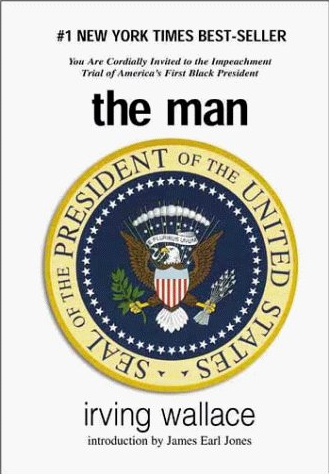
The Man, by Irving Wallace (Book Review) September 14, 2007

Filed under: book reviews,Ethics and Values — gurdas @ :

The Man by Irving Wallace

Warning: This review has spoilers. If you are reading this while still deciding on whether to read the book, I suggest you jump straight to the last paragraph.

When acting president TC dies due to a fluke of destiny, the succession laws implant Douglas Dillman, a black citizen, in the hot seat. Much to the disbelief and chagrin of racist America. The book is about how a nation, which professes equality and liberty as its cornerstones, lies exposed of its hollow inner. Written in the manner of a fast paced novel, it is quite a page turner. While the final showdown is long anticipated, what makes the novel great is that it holds your attention without any grand designs but by small well cooked incidents that add up to the whole. The Man is generously endowed with good to great characterisation. I specially like the characters of Douglas Dillman, Nathan Abrahams and Arthur Eaton. All three are powerful, thoughtful, restrained men. Yet each is different from other. And the author brilliantly sketches each for the difference to be conspicuous.

It is not a classic because no new literary ground is broken in the style of story telling or in the story itself. The novel first published in 1964, is preceded by another novel on racism, the widely considered as classic, “To Kill a Mockingbird”(1960). I would say that some of the characters in The Man draw inspiration from Harper Lee’s book. Douglass Dillman and Nathan Abrahams have shades of Atticus Finch and one can see Calpurnia in Crystal. That is where the similarity ends and that does not take away any credit from Irving Wallace for his noteworthy effort at pulp fiction.

But more than anything else, the novel makes a grand statement on goodness and honesty through the character of its protagonist – Douglas Dillman. He is sharp, intelligent, shy at asking any favours, very sensitive (gets on your nerves) and over-cautious lest he be labelled as showing preferential treatment to his kind. There are parts in the novel where you are angry with this man for being so good that he compromises his position with battle lines drawn. Like when he gives back to Sally Watson the index cards she is sneaking. The subdued acceptance displayed by Doug is where the story hinges and his eventual rise to confidence brings cheer to the reader’s face. Like when Nathan starts to give back the opposition a taste of its own medicine.

The writer keeps you angry long enough to make the retribution sweet. The sheer audacity of lies, the shameless hatred veiled in goodness, and the vocal mudslinging is just perfect to get the reader angry. And angry I was! So much so that while reading the book, there were instances when I had to keep it aside and allow the torrential anger inside me (at the injustice meted out to Doug) to subside. It is fun to be angry, happy, frustrated etc when reading a book because that means you are visualising well. The book is getting to you. But too much of it and you miss the subtle presence of other sub-plots. Like, if you are too angry, you miss the ‘beauty’ of the weasel like tactics affected by the good man’s opponents to trap him. To truly enjoy any read, it is imperative that you enjoy them all – the good guys and the bad guys. The Man provides ample opportunity for both.

There are sections where the novel fails to live up to its own standards. To being with, the manner of TC’s death is hard to digest. What of the purposefully missing interrogation of Eaton (was the author afraid of venturing into the demanding and explosive possibility?). And many sections are done in the manner of a Hollywood movie with its obvious drama, sleaziness and valour. The speeches by Doug could have been better. The characters of Gordon Oliver and Mindy Dillman hold no water. The end holds you to the edge except in the last few paragraphs where you can jump the book and ‘feel’ the outcome.

Some noteworthy sections of the text:
The NY daily editorial warning the country that it is the citizens (and not the new president) who must prove themselves
The ‘keep the door open’ sequence between Doug and Edna
The handling of Leroy Poole by Douglas
The wavering of Edna Foster
The fall and rise of Otto Beggs
The high octane bursts from The Judge
The acerbic and almost always bombastic speeches by Zeke Miller
The interrogation of Wanda Gibson by Zeke Meller

I would recommend The Man to anyone interested at a peak inside colour racism in America. But above that, this novel is a must read for people seeking a finely etched essay on goodness. There is never an excuse for being weak, but then not all (seemingly) signs of weakness are propelled by weakness. Sometimes it is just goodness speaking in its highest form – in the form of Douglas Dillman.

ps: Thanks to AV for recommending (and lending) the book to me.

– – Further reading – –

http://en.wikipedia.org/wiki/The_Man_%28novel%29
http://en.wikipedia.org/wiki/Irving_Wallace
http://www.amazon.com/Man-Irving-Wallace/dp/067103894X (the Indian print costs Rs. 150/-)


India. How rich? OR How poor? September 8, 2007

Filed under: Ethics and Values,India,life,wealth — gurdas @ :

In the wake of our recent economic successes, it is common for Indian dailies to have headlines that scream “India now has 1000 millionaires” or “the stock market added/removed 1000 million dollars to/from investor’s wealth”. Great, right? That will set a few thousand of my countrypeople hurrying towards their million milestone. As if not getting there is some sin. And all this time these millionaires or their lesser cousins, the wannabe millionaires, remain oblivious to news like “India has 220 million people below the poverty line”. Bereft of big brother phrases, it simply means that 220 million people in India struggle to get clean water, recommended dietary input and a roof on their head. Let us not even mention stuff like education and respectable employment. And if you are naive enough to mention justice and equal opportunity, be warned that it will generate a donkey like reaction – motionless & silent or wild kicking of limbs accompanied by hee-hawing; depending on who is listening to your ‘stupidity’.

Here are some facts to slap-end the starry eyed, all is hunky-dory view of India which majority of city dwelling Indians posses (like some genetic disease):

http://en.wikipedia.org/wiki/Demographics_of_India
http://www.csmonitor.com/2006/0626/p01s02-wosc.html
http://www.pon.nic.in/open/depts/ecostat/census/HOMEPAGE.HTM
http://www.censusindia.net/results/

.. 

So, what is the official definition of “poverty line”?
It is based on a 1970s criterion of money required to buy 2400 calories of food!! So, as per today’s figures, if you earned above Rs. 600/- per month, you are not considered below poverty line. Shockingly, the government assumes all your money is spent on food. Based on these assumptions we say that 22% of our population is below poverty line. If we were to be more realistic, the below poverty line figure could be 90% of our population. What does that say about us?

Links to poverty line definition and some number crunching:

A post on the krishworld blog
http://www.indiatogether.org/2006/mar/ddz-povline.htm
http://mospi.nic.in/compenv2000_appendix%206.htm
http://alternativeperspective.blogspot.com/2005/10/being-not-poor-in-india-what-does-it.html
http://www.wakeupcall.org/administration_in_india/poverty_line.php

..

And how do we compare with say America? Well, the 1999 data for US says they have 12.6% (37 million) people “living in poverty”. While there is no justification to being comfortable with one’s misery simply because the person beside you is also miserable, I am sure reading that 37million figure made the Indian poverty look not-so-bad. But wait, poverty in America is not the same as poverty in India.

A poor American is described as “has a car, air conditioning, a refrigerator, a stove, a VCR, a microwave, a stereo, and a color TV. He is able to obtain medical care. His home is in good repair and is not over-crowded. By his own report, his family is not hungry, and in the last year he had sufficient funds to meet all his essential needs.”!!
Read this for more:
http://findarticles.com/p/articles/mi_m1282/is_20_51/ai_56220678
http://timesofindia.indiatimes.com/articleshow/1941247.cms

..

While we continue to pat our backs with statements like “India has arrived on the world stage”, let us stop and ponder on whether we are asking the necessary questions.
The din created by people asking “How rich are we?” is matched by the eerie silence of the question “How poor are we?” Statistics, true to its image of being the devil’s whip, will hardly give the complete picture. We are so bombarded by numbers that there is no time to ponder over what is not stated and the effect of the missing.

To arrive at the right answer it is imperative that we ask the right question. Asking “how rich are we?” serves the vanguard of India’s rich. It glaringly leaves out the poor. Keep looking and working on the front and middle lines and you are bound to leave the trailers far behind. In other words, the rich-poor divide will increase. Asking “how poor are we?” does help focus on trailers and move their kind ahead, but only so much. End result – we will become a society of mediocres.

The preferred path is doing both at an optimum mix. For a country like India, it definitely means doing the “how poor are we?” more frequently than “how rich are we?” Simply because it is far more important to get water to a thirsty mouth than getting Pepsi into the refrigerator. Sadly, the equation is opposite in India.


Creating a paradise on Earth August 31, 2007

Filed under: Ethics and Values,life,love — gurdas @ :

I was wondering what it will take to create a paradise on Earth. The answers I got were that the notion of Paradise is nothing but peace in all its myriad forms. And here is what I truly believe can lay the foundation of everlasting peace on Earth:

.

Total eradication of hunger
Safe drinking water for all
Education for all
Employment for all
Love and respect for fellow humans
Love and respect for our planet and all its inhabitants

.
I have placed them in a logical order on what needs to be tackled first. To me, a man dying of hunger is, arguably, the greatest shame on humanity. Which is why I placed eradication of hunger at the top of the list.

Seeing the list, what strikes me most is that nothing on the list is beyond human reach. Infact, all of it is human creation. If we have the will, it will not take more than 10 years to establish the first four list item as ‘achieved’. That does not mean there will not be the occasional hiccup. But what it means is that the deviation will be rare and will be handled such that peace is not disturbed permanently.

So, the agenda will change from establishing temporary peace to maintaining permanent peace.

As we move down the list, I believe, we will see peace taking form. Conflicts arise when one of these core needs is disturbed. Wars are fought for one or more of the list points. Not all wars will be nullified by the list. The extremists will continue to find reason for war. But they will be so outnumbered that the only real choice will be to let go of their position and embrace peace.

Sounds Utopian, eh? But let me ask, is there a second choice?

Maybe I am just greedy. I don’t want a paradise after death. I want it while alive.


When I see a beggar August 29, 2007

Filed under: Ethics and Values,India,life,love — gurdas @ :

In India, beggars are more visible than honesty. And it seems I have come a full circle on how I view beggars. Long back I used to give generously, then I held back ferociously and now I give selectively.

It is not uncommon for people to see beggars as a nuisance. They are not to blame fully since we have this sea of beggars. They can be found at traffic lights, outside shopping malls and temples amongst other places. But surely we can do better than getting agitated at the very sight of a beggar? Not all of them deserve our anger. Remember, we see more beggars in India because we have created more beggars in India. Decades of government apathy, social boycott and lack of opportunities have led to their creation. Agreed, many beggars are cheats who chose to take the easy path of begging rather than toiling.

Some of us have been duped by beggars who extracted money by concocting lies about hardship, hunger, and even death of a relative who needs to be cremated. Once in a while the dirty beggar’s lie is exposed. Then we return from such incidents promising never to give alms. But how does that change anything for the old crippled beggar who has reached a point where only mercy can keep him breathing? When I see such a beggar I feel ashamed thinking of how little my country and I do to better their lives.

Yesterday, while coming out of a multiplex, I looked into the face of aged, wrinkled beggar. I saw exhaustion, sorrow, and despair in her face. With cars honking for way, I could not stop and ask if she needed anything. Maybe I could have parked somewhere ahead and walked back. But my little self chose to do otherwise. Her face remained with me for quite sometime. I failed to make the right decision.

And I now find myself begging for answers.

Let me ask you: When you are approached by a beggar who deserves your help and you chose to look the other way, who is the lesser beggar? The one who is begging or the one who is refusing? Because the only reason to refuse, IMHO, is when you are a greater beggar and need help more than the beggar in front of you.


Sanjay Dutt gets “Punishment” July 31, 2007

Filed under: Ethics and Values,India,life — gurdas @ :

 The breaking story on all news channels is the 6year jail term handed out to Indian film star Sanjay Dutt. The drama called justice left me thinking on what justice is all about. From the way things go these days and from the choice of words of news reporters, it seems justice is all about punishment. That is something I am very uncomfortable with. I believe society needs to do away with punishment courts and bring in reform courts. Justice should be about healing, reform and correction. Punishment should be an option only when the accused refuses to follow a path of reform or simply refuses to cooperate in a manner beneficial to society. And there is no reason whatsoever to give someone a life sentence. Let us hold that until we know more about life and death, shall we?

Lets take the example of Sanjay Dutt. Without doubt he committed an offence by possessing an AK-56 (amongst other weapons) during the days following 1993 riots. But is that all to it? Who takes responsibility for the failure of law and order leading ordinary citizens to feel threatened and helpless; which leads to them taking desperate measures? Will the government stand trial and will the state chief minister go to jail for not attending to his/her responsibility? I am not trying to justify the crime committed by Dutt, just trying to explain.

Having proven his guilt, one must ask what are the options before us for Sanjay Dutt? The usual option is to hand out a punishment – some jail term. I ask, what purpose does this punishment serve? Does the society and the country benefit by Sanjay Dutt going to jail? Then there is the question of message to aspiring criminals. How about Dutt coming on TV, saying sorry to the country and telling us how much his action cost him in terms of peace of mind and grace? Isn’t that a better message? Hardened criminal minds in any case will not be affected by the punishment given to Dutt. But the “criminal due to drastic circumstances”, such as the Mumbai riots of 1993, will get the message.

How about Sanjay Dutt receiving a punishment that says “you will build an orphanage for children who lose their parents in riots and also build a hospital that attends to trauma patients”. That will benefit society, give Dutt a chance to reform, increase his love for society and increase society’s love and patience with people who are fundamentally good but just happen to commit an anomalous crime.

Possessing a weapon does not make Sanjay Dutt a criminal. He is not a threat to society. And his serving 6 years in jail will not benefit society.

So why are we sending him to jail? Why are we pushing him into a dark cold cell where his spirit will slowly die while he could have been so much more beneficial to society by staying outside? To satisfy our age old dusty notions of justice? An idea being carried forward from the days of monarchs and autocrats; that the criminal must be punished with no concern to the human life which, instead of being reformed, will be destroyed?

And Dutt is only an example I use. There are hundreds and thousands of such people in India who are not criminals but end up being jailed for years simply because out of the millions of moments in their lives, they lost control once. And behind nearly every such crime is the basic failure of the government to create a welfare state. Unfortunately, the government does not stand trail. It is a shame that we forget the hundreds of times these people have been good citizens and human beings. And sending them to jail probably stifles the good more than correct the bad. How sad.

Recent news stories increasingly give the impression that society is becoming intolerant. A fact highlighted by the many police brutalities in the form of lathi charge at protestors. I cannot forget a particular scene in which a policeman is shown holding up the face of a 70 year old man while he boots his cheeks. Repeatedly. The old man was minimally dressed and you could count the bones of his rib cage. And similar pictures are flashed every other month. What are we doing? Is punishment so desirable that we become animals?

I recollect another case which is an example of why our present system of justice is doing no justice to society. The case was of Salman Khan going hunting for Chinkaras – a protected species of deer. His crime is proven without doubt. And the justice system gives him some jail term. How does that help the Chinkara? How about this – ask Salman Khan to contribute 5 crore rupees to a Chinkara protection force and have him serve 3 months in a national park. That will help better the status of Chinkaras and give Salman Khan a path to reform. With each such reform judgment there is the potential to win the momentary criminal and turn him/her into a better human being. Since the “punishment” calls out to the goodness within each of us, people will come to love the idea of justice because it helps them become better humans.

Both Dutt and Khan are not criminals. They did not go murder someone in cold blood or rape someone or burn someone’s house. They are people like you and me who just happened to momentarily go astray.

Why do we call our code as Indian Penal Code? Look up the word ‘penal’ in a dictionary and this is what you get – “Having as its object the infliction of punishment, punitive; prescribing the punishment to be inflicted for an offence” – from the Shorter Oxford Dictionary. Does this sound like something nice? Not to me. Maybe we should have Indian Reform Code.

Am I wrong in sensing that since in India it is very hard to bring a true criminal to justice, the few people who get caught in our legal nets (and who are sometimes nice individuals) get treated to the anger and frustration of our society? At any given time, there must be a few thousand people in Bihar who carry illegal weapons. And they go around shooting people with these. And the government is fully aware of these people. So, what are we doing about them? Nothing. They kill, rape, burn for years and decades and nothing, absolutely nothing happens. But a Sanjay Dutt, gets caught and dragged. We vent all our anger on him. He is punished for being a nice person who made a mistake. Had he been a hardcore criminal, he would have gone scot-free.

Someone on NDTV was saying “the courts cannot be emotional” and I find it very funny. What is wrong about being nice and humane? Is emotion not an integral part of being human? Does that mean the courts are/should be inhuman? How can a momentary error become cause for years in jail? How are we going to account for the goodness done by an individual? If it is hard facts that courts live by, then let us get ALL the facts about an individual. Not just facts relating to a particular case against the individual. Because we will be punishing the person and not just a part of him/her. Let us account for every moment of goodness, every act of kindness that the accused has done. And then let us sum up the good and bad parts and let the result decide the nature and quantum of sentence.

If Sanjay Dutt has been a good citizen otherwise, has contributed to NGOs and has been kind and loving to people around him, then those are also FACTS which must be taken into consideration. Specially in a country like India, where it is particularly difficult to be nice and kind because the system does everything possible to make you angry and frustrated.

I vote for Sanjay Dutt to be set free. Because there are no facts that prove he is a danger to society (while some of our parliamentarians definitely are) and thus needs to be kept behind bars. Infact, sending him to jail is the only real crime in this case.